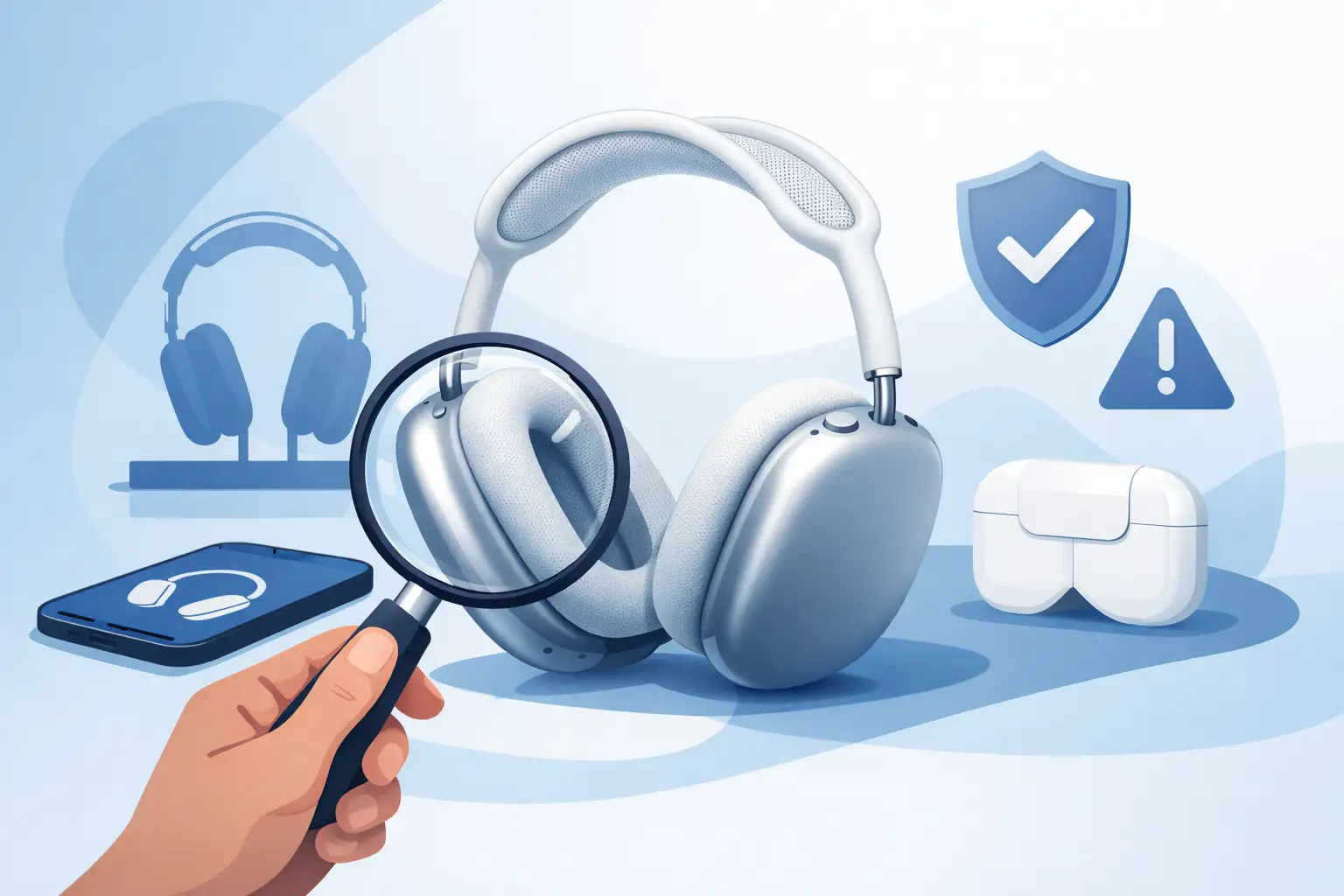
A convincing fake can look acceptable in a marketplace photo, particularly when it is listed as “new”, “unwanted gift” or “refurbished”. The real differences tend to appear once you check the serial number, handling, Apple features and the seller behind the listing. Knowing how to identify genuine AirPods Max means looking beyond the box and price tag before your money changes hands.
Start with the price and the seller
AirPods Max are premium headphones, so an unusually low price is a warning sign rather than a bargain. A used or professionally refurbished pair should cost less than new, but there still needs to be a credible reason for the price. If a seller cannot explain condition, battery performance, included accessories or where the headphones came from, walk away.
Be particularly cautious with private listings that use catalogue images, have no clear returns process, or push for bank transfer, cryptocurrency or payment outside the selling platform. A genuine pair with a fault may still be worth buying if it is honestly described and priced accordingly. A pair presented as perfect with no evidence, no warranty and no protection is a different risk.
For refurbished AirPods Max, ask what “refurbished” actually means. Professional refurbishment should involve functional testing, cleaning, condition grading and checks for audio, charging, Bluetooth and controls. Genuine does not have to mean untouched or box-fresh. It does mean the device itself is authentic and the condition has been represented clearly.
How to identify genuine AirPods Max by serial number
Every authentic AirPods Max has a serial number. On the headphones, remove the left magnetic ear cushion and look inside the ear cup near the top. You should see the serial number alongside regulatory markings and model information.
You can also view the serial number when the AirPods Max are connected to an iPhone or iPad. Open Settings, select Bluetooth, tap the information button next to the headphones, then check the serial and model details. The information should look consistent across the device and Apple settings.
A serial number that Apple recognises is useful, but it is not final proof on its own. Counterfeiters can copy a real serial number and print it on several fake units. Treat it as one check in a wider inspection, not a guarantee. If the number is missing, poorly printed, differs between the ear cup and device settings, or the seller will not let you inspect it, do not proceed.
It is also worth checking the model number shown in Settings. Genuine AirPods Max models vary by release, but the number should correspond with the headphones being sold. A mismatch between the claimed colour, generation and device information deserves an explanation.
Check the build, materials and controls
Real AirPods Max feel deliberately made. The ear cups are aluminium, the telescopic arms are metal, and the headset has noticeable weight. Fakes are often lighter, use more plastic than expected, or have a painted finish that looks uneven around buttons and joins.
Look closely at the headband. The genuine mesh canopy is tightly fitted and evenly woven, while the frame and adjustment arms move with controlled resistance. It should not creak, wobble excessively or feel as though it will catch when extended. Normal wear is possible on a used pair, especially on the mesh, but poor materials and loose assembly are not signs of honest ageing.
The Digital Crown is another strong indicator. On genuine AirPods Max, it turns smoothly with precise clicks and gives reliable volume control. The noise control button should have a clean, firm press. Cheap buttons, delayed commands or a crown that feels rough and imprecise are common counterfeit clues.
The ear cushions should attach magnetically and sit flush with the cups. Their fabric is soft and consistently finished, with left and right markings inside. Replacement cushions exist, so different cushions do not automatically mean the headphones are fake. However, weak magnets, thin padding, rough stitching and badly aligned openings should prompt further checks.
Test the features that fakes struggle to copy
A genuine pair should pair quickly with Apple devices and appear correctly in Bluetooth settings. You should be able to rename the headphones, view serial and firmware information, and use features supported by your device and software version.
Noise Cancellation and Transparency are especially useful to test. With Noise Cancellation enabled, steady external sound such as traffic, a fan or office background noise should reduce noticeably. Transparency should bring surrounding sound through naturally, rather than simply making everything louder or adding a harsh hiss. Neither mode creates total silence, and fit affects the result, but the difference between modes should be obvious.
Test audio from both ear cups at low and high volume. Listen for distortion, crackling, intermittent sound or an imbalance between left and right. Then make a call and check the microphones. Genuine headphones can still develop faults through use, so a fault does not automatically prove a counterfeit. It does tell you the unit needs repair, a lower price or a better option.
If possible, test automatic head detection by removing and putting on the headphones while music is playing. Check spatial audio options where your Apple device and content support them. Also place the AirPods Max in their Smart Case and confirm that they enter their low-power state. Counterfeit models may imitate a pairing pop-up but fail when you test the controls and deeper functions.
Do not rely on packaging alone
A genuine box is neatly printed, with sharp text, accurate product imagery and correctly fitted internal packaging. Spelling errors, faded printing, flimsy cardboard and poorly cut inserts are red flags. The serial number on the packaging should also match the headphones.
Still, packaging is easy to copy, swap or reuse. A genuine box can contain counterfeit headphones, and authentic refurbished AirPods Max may be supplied without their original retail packaging. Put more weight on the product, software behaviour, serial consistency and seller safeguards than on shrink-wrap or a tidy box.
Accessories need the same common sense. The Smart Case should fit closely and align correctly with the headphones. A USB-C or Lightning cable may be original or a quality replacement depending on the model and seller. A non-Apple cable alone is not evidence of a fake, but it should be disclosed rather than used to make the listing look more complete than it is.
Buy refurbished with clear protection
The safest way to reduce counterfeit risk is to buy from a specialist retailer that can account for every pair it sells. Look for detailed condition grades, real product photos where available, a stated testing process, a meaningful warranty and a clear return route. Free tracked delivery is also preferable to an untracked parcel from an unknown individual.
Before buying, check whether the retailer distinguishes cosmetic wear from functional condition. A “Good” grade may show marks or wear but should still be fully tested. A higher grade should describe what is better about the appearance, not imply a different standard of functionality. Battery condition matters too, particularly if you rely on the headphones for commuting, work calls or travel.
MaxFix focuses exclusively on genuine AirPods Max, with professionally tested and verified refurbished stock, clear condition options and a twelve-month warranty. That kind of specialist process gives you more reassurance than trying to judge authenticity from a handful of marketplace photographs.
What to do if you already own a suspicious pair
If you have bought AirPods Max and suspect they are fake, keep screenshots of the listing, messages, receipt and payment record. Do not alter the headphones or discard the packaging until you have raised the issue with the seller or platform. Record the serial number, photograph the markings under the left ear cushion and note which features do not work as expected.
If the headphones are genuine but have weak battery life, connection dropouts, audio faults or damaged components, repair may be the better value choice. Authenticity and condition are separate questions. A genuine pair can often be restored, while a counterfeit pair is unlikely to offer the reliability, safety or software support you paid for.
A careful five-minute inspection can save far more than it costs. Choose proof over promises, test the features that matter to you, and buy from a seller prepared to stand behind the headphones after they arrive.